Ada vs Canyon County Land: What Buyers Should Know Before Building
Ada vs Canyon County Land can look similar on a map, but the building experience can be very different. If you are buying land in Idaho to build a custom home, county lines can affect your budget, permits, driveway access, septic requirements, zoning rules, and long-term property plans.
The Treasure Valley is one of the most desirable places in Idaho to secure acreage for a custom home. Many homeowners are drawn to the open space, views, privacy, and room for shops, animals, gardens, or future outbuildings. However, not every parcel follows the same rules.
Before you close on land, it helps to understand how Ada County and Canyon County can differ. Local regulations, highway district requirements, septic approvals, permit timelines, and available acreage can all change the final cost and building process.
Why Ada vs Canyon County Land Matters When Building
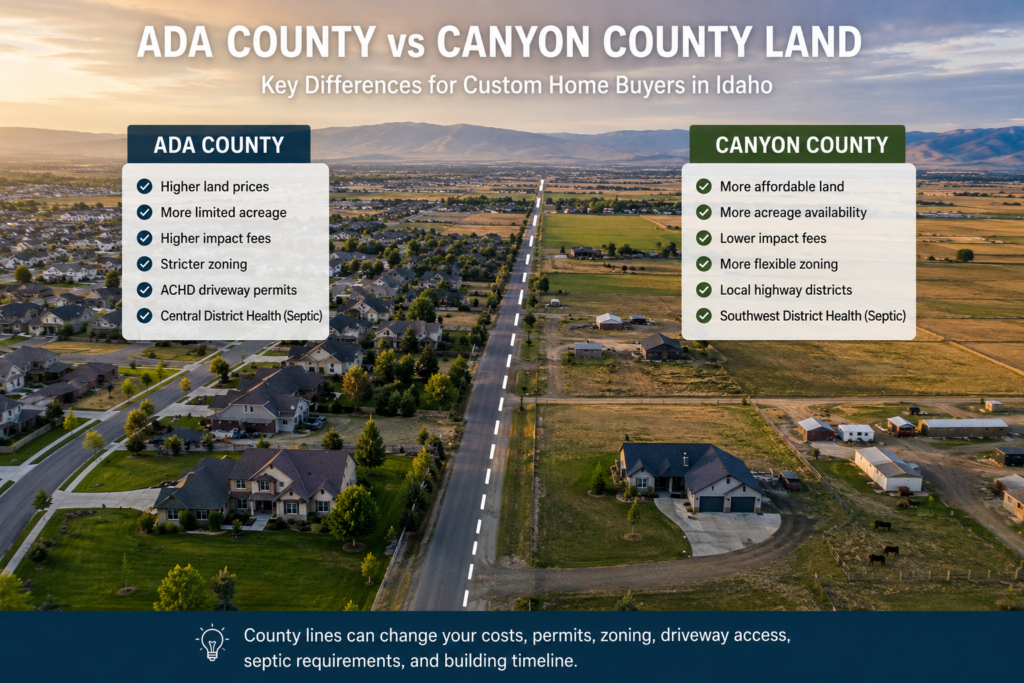
County lines matter because each county, city, highway district, and health district may have different requirements.
Ada County includes Boise, Meridian, Eagle, Kuna, and Star. Canyon County includes Caldwell, Nampa, Middleton, and surrounding rural areas. While both counties are part of the Treasure Valley, they do not always handle land development, permits, access, utilities, and septic approvals the same way.
That difference matters before you buy. A parcel may look affordable at first, but driveway work, septic requirements, utility access, engineering, impact fees, and zoning restrictions can change the full project cost.
A builder who understands local land development can help homeowners ask better questions before closing on a parcel.
Acreage Availability and Idaho Land Prices
One major difference between Ada County and Canyon County is acreage availability.
Ada County has seen major growth for many years. Because of that, available acreage in areas like Eagle, Star, South Boise, and surrounding communities can be limited and expensive. Homeowners may find fewer flat, manageable parcels in the 2-to-5-acre range, especially in highly desirable locations.
Canyon County still offers more agricultural land, open space, and rural acreage opportunities in many areas. Caldwell, Nampa, Middleton, and nearby rural communities may offer more options for homeowners who want privacy, space, and flexibility.
That does not mean every Canyon County parcel is inexpensive or easy to build on. Each property still needs careful review. However, buyers often find more acreage options in Canyon County than in many parts of Ada County.
Comparing Ada vs Canyon County Land Prices
When comparing Ada vs Canyon County Land prices, homeowners should look beyond the cost per acre.
The purchase price is only one part of the total investment. A lower-priced parcel may still need extensive driveway work, utility trenching, septic design, well coordination, grading, drainage improvements, or engineering. A higher-priced parcel may already have better access, utilities nearby, or fewer development challenges.
The better question is not only “What does the land cost?” It is also “What will it cost to make this land buildable?”
Before buying, homeowners should review the land, access, utilities, soil conditions, setbacks, irrigation features, easements, and future building plans. That early review can help prevent expensive surprises after closing.
Permit Costs and Local Impact Fees
Every local jurisdiction has its own process for building permits, impact fees, inspections, and approvals.
Impact fees help pay for the added demand a new home places on roads, parks, schools, fire districts, and other public services. These fees can vary depending on the city, county, and service area. A parcel in one jurisdiction may carry very different costs than a similar parcel nearby.
Ada County and its cities may involve different departments, review steps, and fee structures than Canyon County communities. In faster-growing areas, homeowners may also face more competition for review timelines, inspections, and utility coordination.
Canyon County areas such as Caldwell, Nampa, and Middleton may offer different fee structures and local processes. The exact cost depends on where the parcel is located and which agencies have jurisdiction.
Before buying land, homeowners should ask which city, county, highway district, fire district, irrigation district, and health district will be involved.
Ada vs Canyon County Land Permits and Local Building Rules
Ada vs Canyon County Land can involve different permitting paths.
In Ada County, homeowners may work with city or county building departments, the Ada County Highway District, Central District Health, local fire districts, irrigation districts, and utility providers. The review process can depend heavily on the parcel location.
In Canyon County, homeowners may work with Canyon County, local city building departments, highway districts such as Caldwell Highway District or Nampa Highway District, Southwest District Health, irrigation districts, and utility providers.
These differences matter because no single Treasure Valley permit process applies to every property. A homeowner building near Caldwell may face different steps than a homeowner building near Eagle, Star, Meridian, or Kuna.
A strong builder should help identify which agencies may need to review the project before construction begins.
Property Zoning Laws and Custom Home Outbuildings
Many acreage buyers want more than a main house.
They may also want a detached shop, RV bay, barn, guest house, pool house, garden area, animals, or future Accessory Dwelling Unit. Those goals should be reviewed before the land is purchased because zoning rules can affect what is allowed.
Zoning may influence building size, structure height, setbacks, lot coverage, driveway placement, animals, agricultural use, and future outbuildings. Even when a property has enough physical space, local rules may still limit how that space can be used.
Homeowners should ask about zoning before assuming they can build every structure they have in mind.
Ada vs Canyon County Land Zoning for Shops and ADUs
Ada vs Canyon County Land zoning can affect shops, barns, and ADUs.
In many Ada County areas, zoning and local development standards may be more restrictive due to density, neighborhood planning, existing development, and city requirements. Homeowners may need to review square footage limits, height restrictions, setbacks, access, and design standards before planning a large outbuilding.
Canyon County’s agricultural history can make some rural parcels more suitable for shops, barns, equipment storage, animals, and larger outbuildings. Even so, homeowners should not assume every Canyon County parcel allows the same use. City limits, area of impact rules, subdivision restrictions, CC&Rs, and zoning still matter.
Before buying land, ask whether the property can support your long-term plans, not just the main house.
Highway District Access and Driveway Permits
Raw land must connect legally and safely to a public road.
That usually means the driveway approach needs approval from the proper highway district or road authority. The requirements may include sight-line review, culverts, drainage, approach width, surface material, slope, and distance from intersections or neighboring driveways.
Driveway access can become a major cost on acreage. Long driveways may require excavation, gravel, base material, culverts, grading, drainage planning, and temporary construction access. If the access point needs engineering or special review, the timeline and cost can increase.
Homeowners should never assume that a driveway can go anywhere they want. The driveway location should be reviewed before finalizing the home location and site plan.
Navigating Highway Districts for Road Permits
Ada County properties often involve the Ada County Highway District for driveway access and road-related requirements.
Canyon County properties may involve highway districts such as Caldwell Highway District, Nampa Highway District, or another local road authority, depending on the parcel location. These districts may have different expectations for approaches, culverts, road cuts, and drainage.
Rural parcels often require practical coordination. The road authority may need to confirm safe access, proper drainage, and a driveway approach that works for both construction and long-term use.
Before buying, homeowners should confirm who controls road access and what the driveway approval process requires.
Septic Requirements and Health District Review
Many acreage parcels outside city sewer service require a private septic system.
Septic approval is one of the most important land feasibility items to review before building. A property may look ideal, but the soil, slope, available drain field area, water table, setbacks, and nearby wells can all affect septic design.
Before a building permit can move forward, the septic system usually needs review and approval from the correct health district. This may require test holes, soil evaluation, design work, and coordination with a septic designer.
A septic issue can change the home location, driveway layout, landscaping plans, and future outbuilding options.
Southwest District Health vs. Central District Health
Ada County falls under Central District Health. Canyon County falls under Southwest District Health.
That difference matters because each health district has its own process, forms, review timelines, and septic approval requirements. Homeowners building in Ada County will not always follow the same septic process as homeowners building in Canyon County.
Soil conditions can also vary from parcel to parcel. Canyon County has many agricultural properties, but agricultural land still needs proper septic review. The presence of open space does not automatically mean septic approval will be simple.
Working with a builder who understands local coordination can help homeowners identify the right professionals early, including septic designers, excavators, well drillers, surveyors, and engineers.
Other Costs to Review Before Buying Land
Ada vs Canyon County Land comparisons should include more than permits and acreage prices.
Homeowners should also review:
Driveway length
Power availability
Well requirements
Septic feasibility
Irrigation features
Drainage patterns
Soil conditions
Slope
Easements
Setbacks
Fire district requirements
Future shop or barn plans
Subdivision restrictions
Access for construction equipment
These items can all affect the final project budget.
A parcel that looks simple online may become more complicated once the site is reviewed in person. Early due diligence helps homeowners understand the full cost before they own the land.
Questions to Ask Before Buying Ada or Canyon County Land
Before closing on land in Ada County or Canyon County, homeowners should ask:
Which county controls this parcel?
Is the property inside city limits or an area of impact?
What building department reviews the permit?
Which highway district controls driveway access?
Who reviews septic for this parcel?
Is a private well needed?
Is power available nearby?
Are there easements or irrigation features?
Are there CC&Rs or subdivision restrictions?
Can I build a shop, barn, ADU, or guest house later?
What site costs should I expect before construction starts?
Does the land fit the floor plan and long-term property use?
How Idaho Impact Homes Helps Homeowners Evaluate Land
At Idaho Impact Homes, we help homeowners look at the full picture before building.
That includes the land, access, utilities, septic, wells, power, driveway approach, zoning, site costs, floor plan fit, permits, and future property use. A custom home should be planned around the land, not forced onto a parcel that does not support the homeowner’s goals.
When comparing Ada vs Canyon County Land, buyers should look beyond the purchase price and review the full cost to develop the property before closing.
If you are considering acreage in Caldwell, Nampa, Middleton, or the surrounding Treasure Valley, Idaho Impact Homes can help you understand what questions to ask before you buy.
FAQ
Is Canyon County better than Ada County for acreage?
Canyon County often has more rural acreage options than many parts of Ada County, but the better choice depends on your budget, location goals, utilities, access, zoning, and long-term property plans.
Is land cheaper in Canyon County than Ada County?
In many cases, Canyon County acreage may cost less per acre than highly desirable Ada County areas. However, homeowners should also review site costs, utilities, septic, driveway access, and development requirements before comparing total cost.
Do Ada County and Canyon County have different septic requirements?
Ada County falls under Central District Health, while Canyon County falls under Southwest District Health. Each health district has its own septic review process and requirements.
Can I build a shop or ADU on acreage in Idaho?
Possibly, but zoning, setbacks, lot coverage, subdivision restrictions, and local rules will determine what is allowed. Homeowners should confirm these details before buying land.
Should I talk to a builder before buying land in Idaho?
Yes. A builder can help you review access, utilities, septic, site costs, driveway requirements, zoning, and floor plan fit before you close on a property.
Planning to Buy Land in Idaho?
If you are comparing land in Ada County, Canyon County, Caldwell, Nampa, Middleton, Boise, Eagle, Star, Kuna, or the surrounding Treasure Valley, Idaho Impact Homes can help you understand what to look for before you buy.
Contact Idaho Impact Homes to schedule a land feasibility conversation before committing to your property.